


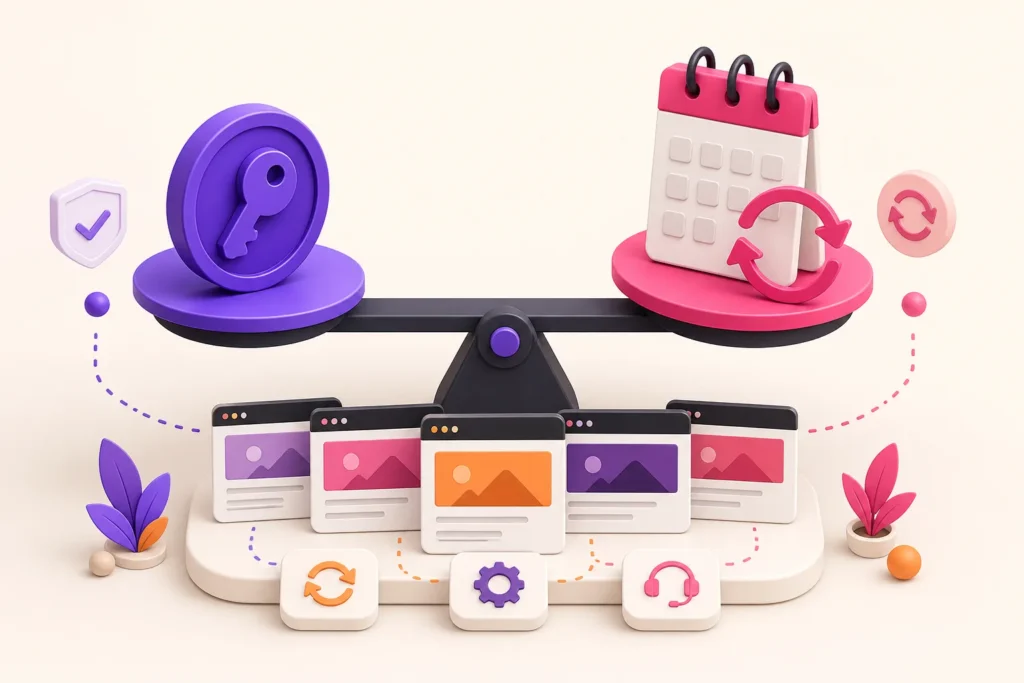
A one-time licence can look dramatically cheaper than an annual subscription. An annual plan can look easier to trust because updates and support are visibly funded. Neither conclusion is reliable without reading what the licence actually includes.
Agencies should compare one-time WordPress plugin licences and subscriptions across entitlement, services, maintenance, site limits, risk and total operating cost.
Price is only the first field
Two products with similar features can fund very different delivery models.
An annual subscription may include ongoing updates, support, cloud processing, storage or usage credits. A one-time purchase may include perpetual use of a released version, updates for a defined period, lifetime updates under stated terms, or no hosted service at all.
“Lifetime” also needs a definition: the lifetime of the product, company, account, entitlement or support policy may not be the same thing.
Read the current licence and service terms before calculating savings.
Compare the complete entitlement
For each option, record:
| Question | Why it matters |
|---|---|
| How many production sites are allowed? | Determines portfolio fit |
| Do staging and local sites count? | Affects development workflow |
| Are updates included, and for how long? | Influences compatibility and security |
| Is support included? | Changes internal support burden |
| Are cloud features or credits required? | Creates usage-dependent cost |
| Can the licence move between clients? | Matters during offboarding |
| What remains after expiry? | Defines operational continuity |
| Are major versions included? | Prevents unexpected repurchase |
| Can data be exported? | Protects the exit path |
| Who owns the account? | Determines control and handover |
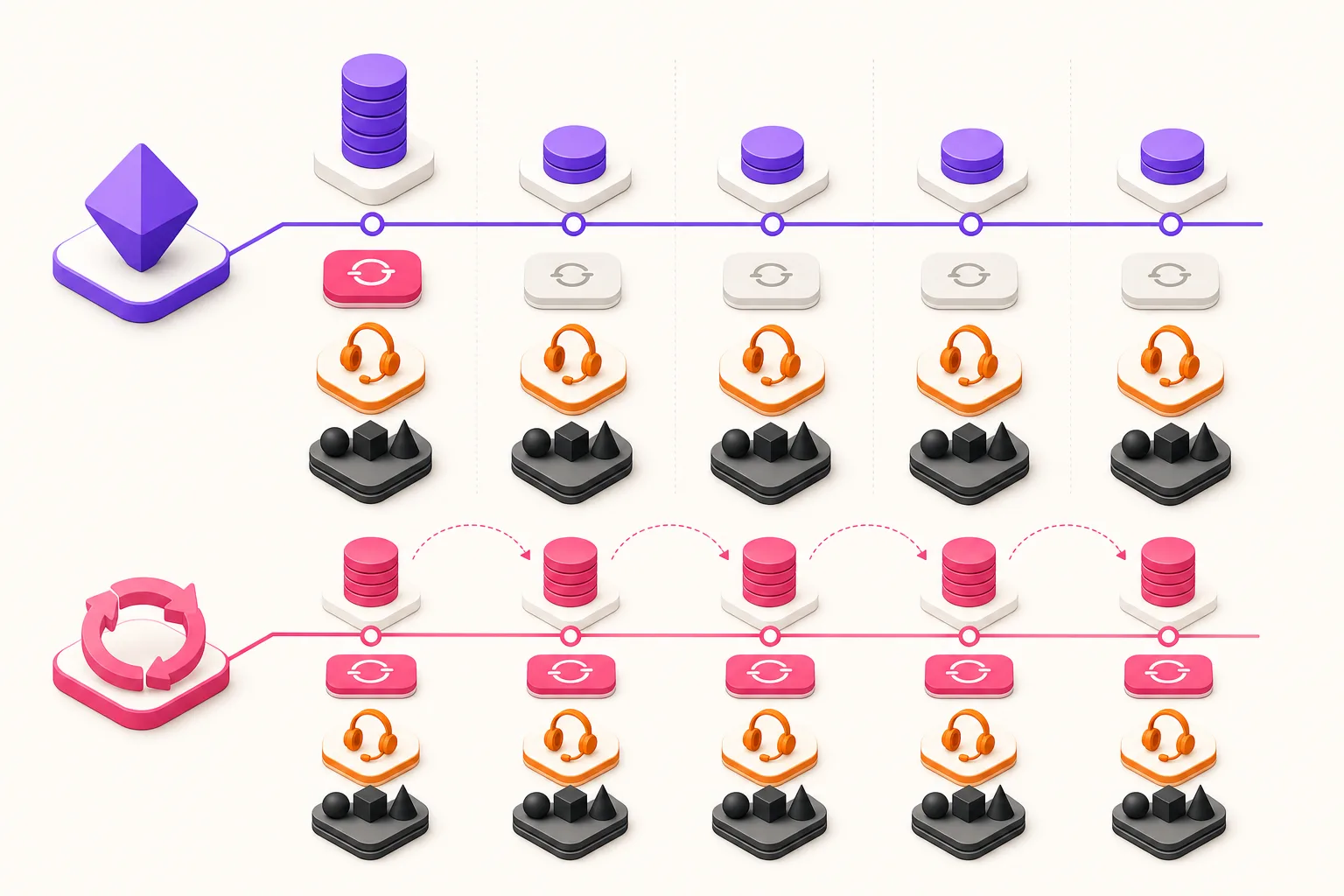
Model total cost over several years
Use at least a three- or five-year view.
Include:
- purchase and renewal fees;
- site-tier upgrades;
- API or usage charges;
- paid support;
- migration and setup;
- training and documentation;
- administration of licences;
- expected replacement cost;
- internal time maintaining the solution.
A one-time licence with heavy manual maintenance may cost more operationally than a subscription. A stable WordPress-managed tool may cost less than several recurring products even after allowing for agency support time.
Calculate low, expected and high-growth scenarios. Client count and site allowances can change the comparison more than the headline licence price.
Evaluate update sustainability
WordPress, PHP, browsers and third-party APIs continue to change. A perpetual right to use old code is not the same as a maintained compatibility path.
Ask the vendor:
- how updates are delivered;
- whether security and compatibility fixes are included;
- what happens if development stops;
- whether the plugin can still operate without its licensing server;
- whether external API changes require a maintained version;
- whether the agency can retain a known working release.
WordPress recommends keeping plugins updated and having a current backup before applying updates. The commercial model does not remove that operational requirement.
Distinguish software from hosted service
Some features cannot be delivered by plugin code alone. Translation providers, email delivery, remote scanning, cloud storage and external data feeds may have ongoing infrastructure costs.
A one-time plugin licence may still require separately billed API services. An annual subscription may bundle those services. Compare both the software entitlement and every external dependency.
Avoid describing a WordPress-managed product as completely self-contained when it calls third-party services.
Consider agency and client ownership
An agency-wide licence can simplify standardisation but complicate handover if the client leaves. A client-owned licence can improve independence but create fragmented renewal administration.
Define:
- who buys and controls the account;
- who pays future external-service charges;
- whether the licence is transferable;
- what the client receives at contract end;
- whether the site continues to function without agency credentials;
- who owns updates and support after handover.
Put the arrangement in the service agreement and site inventory.
Compare risk, not only features
Score each option against:
- vendor continuity;
- release quality and changelog transparency;
- compatibility with the agency’s standard stack;
- data portability;
- security response;
- dependency on remote licensing or cloud services;
- rollback and previous-version availability;
- documentation and support quality.
A lower recurring bill is not valuable if it creates an unsupported critical dependency.
Review the WpAgencyKit model
WpAgencyKit offers one-time licence options for its WordPress tools. Review the current licence terms for site limits, updates and applicable conditions rather than relying on a general assumption about one-time purchases.
The WpAgencyKit Bundle may be useful where an agency needs its deployment, consent, menu, SEO and translation functions and wants to reduce overlapping licence administration. External translation or AI provider charges remain separate where those services are configured.
Watch for misleading comparisons
Pause the decision when a proposal:
- compares a one-site price with an agency-wide tier;
- ignores API or usage charges;
- treats support and updates as identical;
- assumes staging sites never count;
- uses the first-year promotional price as the normal annual cost;
- calls a licence transferable without checking the terms;
- treats continued front-end operation as proof that updates remain licensed;
- assumes all “lifetime” offers use the same definition.
Rebuild the comparison with like-for-like site counts, services, currencies and time periods.
Decision checklist
Choose only after confirming:
- required capabilities and real site count;
- staging and development allowances;
- update and support duration;
- external API and hosted-service costs;
- data and licence ownership;
- client handover route;
- three- or five-year total cost;
- maintenance and security responsibility;
- vendor and exit risk;
- tested compatibility with a representative site.
Choose the operating model you can support
One-time licences can reduce recurring software charges and give agencies a clearer ownership model. Annual subscriptions can fund ongoing services and make support entitlement predictable.
The better choice is the one whose terms, dependencies and long-term responsibility match the agency’s delivery model. Compare evidence, document ownership and preserve an exit route.